CALL NOW FOR A FREE QUOTE 866.760.8194

What Waste Reporting Metrics Matter Most
Every organization generates waste, but not every organization knows what that waste is costing them or where opportunities for improvement exist. Waste reports often contain pages of numbers, yet many businesses struggle to determine which data actually supports better decision-making.
The most valuable waste reporting metrics go beyond simple disposal totals. They help organizations identify unnecessary expenses, compare performance across locations, improve recycling efforts, and uncover operational inefficiencies. By focusing on the right data, businesses can make informed decisions that support both financial goals and sustainability initiatives.
This guide explores the waste management metrics that matter most, why they are important, and how organizations can use them to improve performance over time.
Why Waste Reporting Matters More Than Ever
Waste reporting has evolved into an important business tool rather than simply an administrative task. Rising disposal costs, increasing sustainability expectations, and the need for greater operational visibility have made accurate reporting more valuable than ever.
Organizations with multiple locations often work with several waste haulers, each providing reports in different formats. Without standardized reporting, it becomes difficult to compare locations, identify trends, or understand where costs are increasing.
Effective reporting allows businesses to:
- Monitor waste generation over time
- Compare performance between facilities
- Identify opportunities to reduce hauling costs
- Measure recycling performance
- Support sustainability reporting metrics
- Evaluate vendor performance using consistent data
Rather than collecting information for the sake of reporting, organizations should focus on metrics that help improve day-to-day operations and long-term planning.
What Makes a Waste Reporting Metric Valuable?
Not every data point deserves equal attention. The most useful waste management KPIs help organizations answer practical questions that lead to measurable improvements.
A valuable metric should be:
- Consistent across every location
- Easy to verify
- Actionable
- Comparable over time
- Relevant to operational or financial goals
For example, knowing the total number of waste pickups each month provides information, but understanding the cost per pickup or identifying locations with unusually high service frequency creates opportunities to reduce expenses.
The goal is to transform raw data into business intelligence that supports smarter decisions.
The Most Important Waste Management Metrics to Track
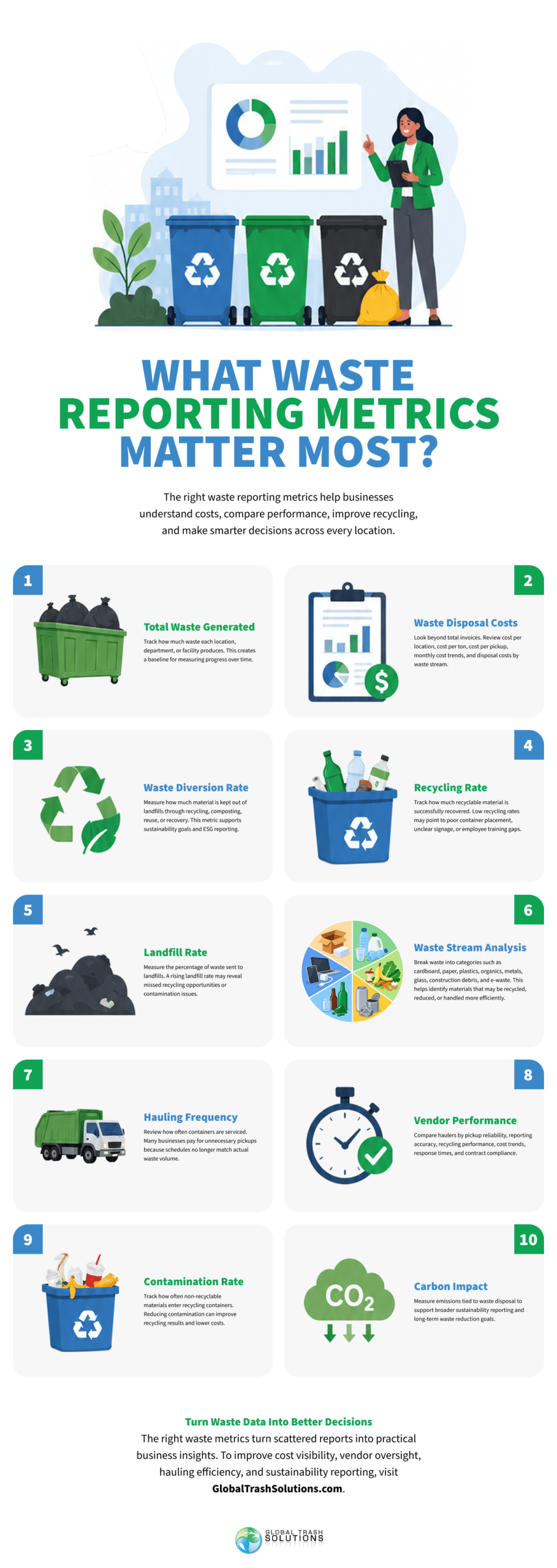
Total Waste Generated
One of the most fundamental waste management metrics is total waste generated.
This metric establishes a baseline for measuring future improvements and helps organizations understand how much material they produce over time. Tracking total waste by location, department, or facility also makes it easier to identify unusual increases that may indicate operational changes or inefficiencies.
While total waste alone does not explain performance, it provides the foundation for every other KPI for waste management.
Waste Disposal Costs
Many organizations monitor their total waste invoices but overlook the details that influence those costs.
Instead of reviewing only overall spending, consider tracking:
- Cost per location
- Cost per ton
- Cost per pickup
- Monthly cost trends
- Disposal costs by waste stream
Breaking waste disposal costs into smaller categories helps reveal billing discrepancies, unnecessary services, or locations that could benefit from adjusted pickup schedules.
Waste Diversion Rate
The waste diversion rate measures how much material is diverted away from landfills through recycling, composting, reuse, or other recovery methods.
A higher diversion rate often indicates stronger recycling programs and more effective waste separation practices.
Tracking this metric over time allows organizations to measure progress toward sustainability goals while identifying locations where additional training or infrastructure may improve performance.
Because many companies include diversion rates within ESG reporting, it has become one of the most widely recognized sustainability reporting metrics.
Recycling Rate
Although frequently confused with diversion rate, recycling rate focuses specifically on recyclable materials that are successfully recovered.
Monitoring recycling performance helps organizations evaluate the effectiveness of their recycling programs and identify contamination issues that reduce recovery rates.
Improving recycling often requires both employee education and properly designed collection systems.
Landfill Rate
Landfill rate measures the percentage of waste that ultimately ends up in a landfill.
A rising landfill rate may indicate:
- Poor recycling participation
- Increased contamination
- Operational inefficiencies
- Missed diversion opportunities
Monitoring landfill trends helps organizations prioritize initiatives that reduce disposal costs while supporting sustainability objectives.
Waste Stream Analysis
Not all waste has the same value or disposal cost.
Conducting waste stream analysis allows organizations to understand exactly what materials they generate, including:
Breaking waste into individual material streams helps businesses identify recycling opportunities, improve procurement decisions, and reduce unnecessary disposal expenses.
Waste stream analysis is particularly valuable for organizations looking to increase diversion rates or implement targeted waste reduction programs.
Hauling Frequency
One overlooked metric involves how often waste containers are serviced.
Organizations frequently pay for pickups that are unnecessary because service schedules have not been updated to reflect actual waste generation.
Monitoring hauling frequency alongside container fill levels helps businesses optimize service schedules, reduce transportation costs, and improve operational efficiency.
Vendor Performance
Waste reporting should also evaluate service providers.
Organizations may compare vendors using metrics such as:
- Pickup reliability
- Reporting accuracy
- Recycling performance
- Cost trends
- Response times
- Contract compliance
Consistent reporting makes it easier to benchmark vendors and identify opportunities for service improvements or contract negotiations.
Contamination Rate
Contamination occurs when non-recyclable materials enter recycling containers or recyclable materials are disposed of incorrectly.
High contamination rates can increase disposal costs while reducing recycling effectiveness.
Tracking contamination helps organizations identify education opportunities, improve signage, and strengthen waste diversion programs.
Carbon Impact
Many organizations now include greenhouse gas reductions as part of their sustainability reporting metrics.
Tracking emissions associated with waste disposal provides additional insight into environmental performance while supporting broader ESG initiatives.
Although carbon reporting may not be required for every organization, it continues to grow in importance as sustainability reporting evolves.

Which Metrics Matter Most for Different Organizations?
The most important waste metrics often depend on the type of organization.
Multi-Location Businesses
Organizations with multiple facilities benefit from standardized reporting that allows them to compare locations using consistent KPIs.
Priority metrics often include:
- Waste generation by location
- Cost per facility
- Vendor performance
- Waste diversion rate
- Recycling performance
Manufacturing Facilities
Manufacturers often focus on production-related waste.
Useful metrics include:
- Material recovery
- Scrap generation
- Waste stream analysis
- Disposal costs by production line
- Recycling revenue
Retail Businesses
Retail operations frequently prioritize:
- Cardboard recycling
- Compactor utilization
- Hauling frequency
- Waste costs by store
- Diversion rates
Commercial Properties
Property managers often monitor:
- Tenant participation
- Overflow incidents
- Recycling contamination
- Service frequency
- Waste costs by property
Selecting the right KPIs ensures reports remain focused on operational improvements rather than unnecessary data collection.
Common Waste Reporting Mistakes
Even organizations that collect extensive data can overlook valuable insights.
Common reporting mistakes include:
- Tracking total costs without analyzing cost drivers
- Using inconsistent reporting formats across vendors
- Failing to compare facilities
- Ignoring contamination trends
- Measuring only landfill volume
- Reviewing reports too infrequently
- Collecting data without acting on findings
Improving reporting often starts with simplifying the metrics that matter most and ensuring they remain consistent across every location.
From Data to Results With Global Trash Solutions
As organizations grow, spreadsheets often become difficult to manage, and that is where Global Trash Solutions (GTS) delivers real value. Our team of waste brokers and waste consultants works alongside businesses to simplify reporting, reduce costs, and uncover opportunities that often go unnoticed.
With our waste tracking software, IntellaWaste, organizations can centralize data from multiple locations, monitor key waste management KPIs, and gain clear visibility into waste volumes, service frequency, diversion rates, and vendor performance.
By combining advanced technology with expert guidance, GTS helps turn waste data into actionable insights that improve operational efficiency, strengthen sustainability efforts, and drive smarter decisions across every facility. Contact Global Trash Solutions today to learn how we can help you take control of your waste reporting and start seeing measurable results.
Frequently Asked Questions
What are waste management KPIs?
Waste management KPIs are measurable indicators used to evaluate the performance of a waste program. Common examples include total waste generated, waste diversion rate, recycling rate, disposal costs, contamination rate, and hauling frequency.
What is the most important KPI for waste management?
There is no single KPI that applies to every organization. Most businesses benefit from tracking total waste generated, disposal costs, waste diversion rate, recycling performance, and waste stream analysis together to gain a complete view of performance.
How often should waste reports be reviewed?
Most organizations review waste reports monthly to monitor trends and identify issues before they become larger operational or financial concerns. Facilities with higher waste volumes may benefit from more frequent reporting.
How does waste tracking software improve reporting?
Waste tracking software centralizes reporting, standardizes data from multiple locations, automates dashboard creation, and helps organizations monitor waste management metrics more efficiently.
Recent Post
Types of Commercial Waste Streams Explained
Nearly every business generates multiple types of waste, but those materials do not…
Read More >Recycling Contamination: Causes and Solutions
Recyclable material can quickly lose its value when food residue, plastic film, or…
Read More >